Top
Attending and watching are different products, and each keeps reshaping the other
The stadium experience and the screen experience were once the same event seen from different distances, but each has been redesigned around the other for so long that they now offer genuinely different things.
Coverage did not simply observe the event
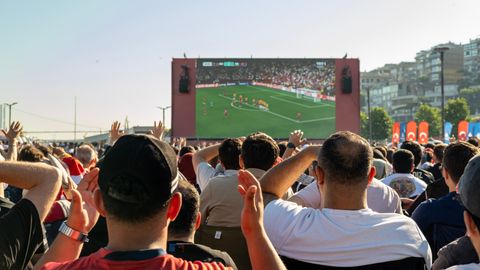
The earliest coverage of live sport presented itself as a window, offering distant audiences a view of something happening whether or not anyone was pointing a camera. That framing stopped being accurate as soon as the event began adjusting itself to be more legible on a screen than it was in a stand. Markings, kit colours and playing surfaces were all altered over time to reproduce clearly through a lens, and the pauses in play settled into patterns coverage could use.
The event and its coverage became a single system, and it is no longer possible to describe one without describing what the other did to it. Anyone who treats broadcast as a neutral window will keep being surprised by decisions that only make sense once the camera is included in the picture.
What a screen gives you that a seat cannot
A screen supplies replays from several angles, close detail on individual moments, and a running explanation of what has just happened and why it mattered. It also supplies information from beyond the venue, so a viewer knows about events elsewhere that directly affect what they are watching in front of them. The picture is chosen by someone whose job is to be looking in the right place, which removes the risk of missing a moment by looking the wrong way.
For understanding an event in detail, the screen is simply the better instrument, and no amount of nostalgia for the terraces changes that comparison. This is why people who attend regularly still watch coverage of matches they were physically present at, since the two experiences answer different questions.
What a seat gives you that a screen cannot
Attendance supplies the whole field at once, so a spectator can watch the movement away from the ball that coverage necessarily crops out of the frame. It supplies sound that has not been mixed, including the parts of a crowd that a broadcast balance deliberately suppresses to keep commentary intelligible. Most of all it supplies presence, meaning the sense of having been in the room when something happened rather than having received an account of it.
Presence is not an information product and cannot be improved by better cameras, which is why its value has held up as coverage has become extraordinary. The two are therefore not competing to do the same job, even though they are frequently discussed as though one must eventually replace the other.
Venues now design for both audiences
Modern venue design treats the people in the seats and the people on screens as two audiences that have to be served by the same building. Large screens inside the bowl exist because spectators began to expect the replay that they would have received at home, and their absence became conspicuous. Camera positions, lighting levels and even the geometry of certain stands are settled with the requirements of coverage built into the brief from the beginning.
At the same time, atmosphere is now treated as an asset rather than a by-product, because a flat crowd degrades the product that coverage is selling. The building therefore has to manufacture the very thing that only attendance can supply, which is a genuinely awkward design problem.
The feedback loop has no obvious end
Each improvement to coverage raises the standard that attendance is implicitly measured against, and venues respond by importing more of the screen experience indoors. Each of those imports makes the stadium a little more like a very large living room, which erodes part of what made attending distinct in the first place. Meanwhile coverage keeps reaching for the things it cannot reproduce, adding crowd microphones and immersive angles in an attempt to convey presence.
Neither side can win this exchange, because each is chasing the property that the other holds by virtue of its basic physical situation. The loop is stable rather than resolvable, and it explains most of the changes a long-standing supporter notices in both the ground and the coverage.
- Coverage changed the event it was built to capture
- Attendance sells presence, not information
- Venues now design for both audiences at once
Also by Aarav Sharma
- Dynamic pricing behaves like a thermostat, which is why a ticket price movesTicket Guides
- How a room's layout decides whether a crowd watches together or in fragmentsSports Bars & Pubs
- How a season of coverage is planned long before anyone knows which matches will matterBroadcast Schedules
- A ground pass buys optionality, and that changes how the whole day is spentWimbledon