Sports Bars & Pubs
How a room's layout decides whether a crowd watches together or in fragments
The difference between a venue that generates collective reaction and one that produces scattered noise is almost entirely a matter of whether the crowd can see itself as well as the screen.
Reaction is contagious only when it is visible
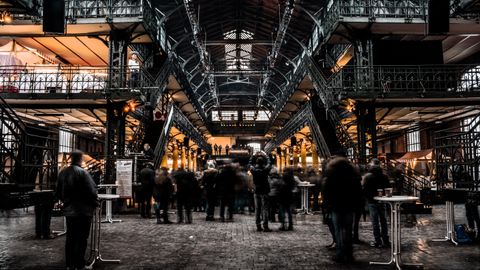
A crowd reacts as a unit when each person can see and hear others reacting, because the response amplifies rather than dissipating in isolation. That requires a room in which a substantial share of the crowd is within sight of a substantial share of the rest, which is a geometric property. A single large open space achieves it easily, while a set of connected smaller rooms does not, however good the screens in each of them are.
The reaction in a fragmented venue arrives as a series of separate noises that never combine into the single roar people associate with watching in public. This is why some venues feel electric with a modest crowd while others feel flat when they are completely full.
What breaks a sightline
Structural columns, partitions and changes in floor level all divide a room visually, even when they leave it physically continuous. A bar counter positioned across the middle of a space is one of the most effective dividers, since it stops movement and blocks the view simultaneously. Seating arranged in booths turns a crowd into a set of small groups facing inward, which is excellent for conversation and poor for collective reaction.
Even a change in ceiling height alters how sound moves and can make two halves of the same room feel like separate spaces. None of these are avoidable in an existing building, which is why venue selection matters more than venue improvement.
Standing rooms behave differently from seated ones
A standing crowd can move, turn and cluster, which lets it reorganise itself around whatever is happening on the screens. It also removes the physical commitment of a seat, so people drift towards the parts of the room where the atmosphere is best. Seated crowds are static by definition, and a seated venue therefore has whatever distribution it had when everyone sat down.
The reaction from a standing crowd is louder for simple physical reasons, since standing people can raise their arms and project more easily. Venues that want atmosphere therefore keep a standing area even when seating would be more comfortable and more profitable per square metre.
The focal point problem
A room with one screen has an unambiguous focal point, and every person in it is oriented the same way by default. A room with many screens showing the same feed keeps the orientation but spreads the crowd, which weakens the sense of a shared direction. A room with screens showing different events fragments the crowd deliberately, which suits a venue serving several audiences at once.
Each of these is the right answer for a different night, which is why good venues can reconfigure what is shown where. The mistake is to run a fragmented configuration on a night when a single fixture has drawn the entire room.
Capacity and comfort set the ceiling
A room that is uncomfortably full produces a poor experience regardless of atmosphere, since people cannot see, move or be served. Venues manage this by controlling entry once a room reaches the level their plan permits, which is a safety requirement rather than a preference. The occupancy limits, entry arrangements and exit routes for any venue are set by the operator under local licensing and fire safety rules.
Their instructions on the night are the operative ones, and a venue that turns people away at a significant fixture is doing exactly what it should. For supporters, the practical implication is simply that arriving early is the only reliable way into a room that will fill.
- Collective reaction requires people to see each other react
- Sightline breaks split a room into separate audiences
- Standing areas generate more reaction than seated ones
Also by Aarav Sharma
- Dynamic pricing behaves like a thermostat, which is why a ticket price movesTicket Guides
- How a season of coverage is planned long before anyone knows which matches will matterBroadcast Schedules
- A ground pass buys optionality, and that changes how the whole day is spentWimbledon
- Attending and watching are different products, and each keeps reshaping the otherTop