FIFA
Fan festivals exist to solve a problem that stadium capacity cannot
Official public viewing sites are not an afterthought for people who failed to get tickets; they are the mechanism by which a host city absorbs a crowd many times larger than its stadium.
The arithmetic that makes them necessary
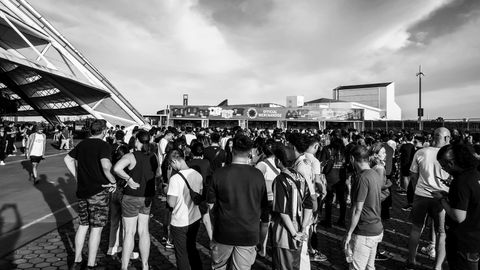
A tournament fixture draws a stadium full of ticket holders and, in a host city, a far larger number of visitors who have no entry at all. Those visitors will watch the match somewhere regardless, and if no provision is made they will distribute themselves across bars, squares and streets unpredictably. An unmanaged distribution is the harder problem for a city, because crowd density then forms wherever it happens to form rather than where it can be handled.
A designated site inverts that, drawing a predictable share of the overflow to a location chosen in advance for its access, capacity and exits. The festival is therefore a crowd management instrument first and a hospitality offer second, whatever the promotional material suggests.
Why the site is where it is
Sites are selected for their transport connections, since a large crowd arriving and leaving in concentrated bursts overwhelms anything that is not already a hub. They need multiple independent exits, because a space with one way out cannot be cleared at the rate a crowd disperses when a match ends. Open ground with hard surfacing is preferred over parkland, as the latter degrades quickly under sustained footfall and becomes hazardous in rain.
Proximity to the stadium is usually avoided rather than sought, since two large crowds moving through the same corridor at the same time is precisely what planners want to prevent. These constraints explain why festival sites are so often the same handful of civic spaces used for every other large public event in a city.
The atmosphere is genuinely different
A stadium crowd is sorted by allegiance, with each end holding supporters of one team and the noise organised around that division. A festival crowd is mixed, containing supporters of both teams alongside neutrals watching whatever is on because they are in the city for the tournament. That mixture produces a looser, more social atmosphere in which the reaction to a goal is split across the same space rather than concentrated in one half of it.
It also produces a more forgiving environment for people attending with children or for anyone who finds a partisan stand uncomfortable. Supporters who have experienced both frequently describe them as different events rather than as a first choice and a substitute.
What the operation looks like underneath
Screens are positioned and sized so that sightlines work from the back of the intended capacity, which limits how much crowd a single screen can serve. Sound has to be loud enough to carry across open ground while remaining within the limits a city sets for residential areas nearby. The feed shown is supplied under an arrangement with the rights holder, which is why the presentation often differs from what the same viewer would see at home.
Entry is usually controlled by counting rather than ticketing, with the site closing to new arrivals when it reaches the capacity its plan permits. Anything concerning entry, capacity or movement on the day is set by the venue operator and local authority, and their instructions supersede any general description.
Why they have become part of the tournament proper
Host cities discovered that a well-run festival generates the visible public celebration that the tournament wants and the stadium cannot produce at scale. Coverage of the tournament now regularly cuts to these sites, which turns them into part of the broadcast rather than a peripheral local arrangement. That visibility raised the standard expected of them, and the modern versions are substantial temporary venues with the staffing that implies.
It also means the festival is planned alongside the fixtures rather than added afterwards, with its own schedule covering matches involving neither host nor visiting nation. For a large share of people who travel to a tournament, this is now the primary way they watch it rather than the fallback.
- A host city attracts far more visitors than its stadium admits
- Fan sites concentrate crowds where they can be managed
- The atmosphere differs from a stadium because the audience is mixed
Also by Neha Gupta
- Why leaving a stadium takes longer than arriving, and how design tries to fix itArena Experiences
- Safe standing changed the geometry of a stand before it changed the noiseFan Zone
- Most streaming failures on a big night are congestion, not a broken serviceStreaming Guides
- What spectators are actually waiting for when rain stops a cricket matchICC