Fan Zone
Safe standing changed the geometry of a stand before it changed the noise
Rail seating is a structural answer to the fact that people stood anyway, and its effects on sightlines, capacity and crowd density are more significant than its effect on atmosphere.
The problem it was designed to solve
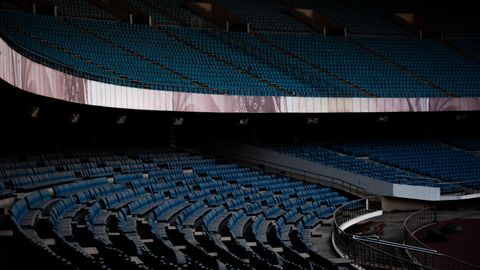
In many grounds a substantial part of the crowd stood throughout fixtures in areas built for seating, which created a risk the design never anticipated. Standing spectators in a row of seats have nothing in front of them at waist height, so a surge or a stumble can carry people forward down the rake. Enforcement of seating in those areas proved impractical, since it required stewards to act against large numbers of people doing the same thing.
Rail seating accepts the behaviour and engineers for it, placing a barrier at each row so that any forward movement is arrested immediately. It is therefore a safety intervention responding to reality rather than a concession made for atmosphere.
How the installation actually works
Each position consists of a defined space with a robust rail in front of it, and in most designs a seat that can be locked upright or folded down. The lockable seat allows the same area to be used as a seated area when a competition or a fixture requires it, which is why the design is so widely adopted. Row spacing has to accommodate both standing and seated use, which usually means the converted area holds a similar number of people rather than many more.
The rails themselves are engineered to a load specification, since their entire purpose is to withstand the force of people pressing against them. The specifications, capacities and permitted uses are set by the ground's licence and the relevant safety authority for each venue.
What changes for spectators nearby
A standing area affects the people behind it, since anyone seated in the rows above is now looking over a standing crowd rather than a seated one. Grounds handle this by placing standing areas at the back of a tier or by converting whole blocks, so the boundary falls where it obstructs fewest people. Within the area itself, sightlines improve for many spectators, because standing raises eye level above the row in front more effectively than sitting does.
The defined space also stops the compression that used to occur when a standing crowd on ordinary seating gradually drifted together. Those spatial effects are the concrete changes, and they arrive whether or not the area turns out to be louder.
The atmosphere question
Supporters advocating for standing areas usually argue in terms of atmosphere, and grounds that install them frequently report that those sections are louder. The mechanism is not the standing itself but the concentration of people who chose that area, which selects for the crowd most likely to sing. A standing area allocated by application therefore assembles a core group in one place, which is the same thing a designated singing section does.
This makes it difficult to separate the effect of standing from the effect of sorting, and the two are usually introduced together. What is clear is that the areas work, though the reason may be less about posture than the advocacy suggests.
Why adoption has been uneven
Conversion costs money, requires regulatory approval and, in some jurisdictions, required a change in the rules before it was permitted at all. Competitions differ in whether they allow standing, which means a club may need an area that can be converted back for certain fixtures. Grounds with older structures face additional engineering questions about whether the existing tier can accommodate the required barriers.
Where all of these align, adoption has been rapid, and where any of them does not, clubs have simply continued as before. The pattern across countries reflects regulation far more than it reflects any difference in what supporters want.
- Rail seating addresses the risk created by persistent standing
- Each spectator gets a defined space and a barrier in front
- Capacity and sightlines change measurably in a converted area
Also by Neha Gupta
- Why leaving a stadium takes longer than arriving, and how design tries to fix itArena Experiences
- Most streaming failures on a big night are congestion, not a broken serviceStreaming Guides
- What spectators are actually waiting for when rain stops a cricket matchICC
- Fan festivals exist to solve a problem that stadium capacity cannotFIFA