Broadcast Schedules
The outside broadcast compound is a small factory, and it explains a lot about coverage
Behind every live fixture sits a temporary technical facility assembled in a car park, and its size, layout and power supply determine what the audience is able to see.
What is actually in the compound
A live fixture is served by a cluster of vehicles parked outside the venue, containing the vision mixing gallery, audio control, replay operators and engineering. Cables run from that cluster to every camera position, every microphone and every commentary position inside the venue, which is why setup takes far longer than the event. Additional units handle graphics, the feed for other carriers, and the connection that carries the finished programme away from the site.
When several broadcasters cover the same fixture, each may bring its own facility, which is why a compound can occupy a substantial area. Everything is struck afterwards and moved to the next venue, so the whole facility exists only for the duration of the fixture.
Power and connectivity set the limits
A compound draws significant power, and venues that host coverage regularly install dedicated supplies precisely so that a generator is not needed every time. Where that supply does not exist, generators are brought in with their own redundancy, because losing power mid-event is the one failure that cannot be recovered. The outbound connection is the other critical dependency, and it is almost always duplicated by a second independent path.
Venues on the regular circuit have permanent fibre for this reason, while occasional venues rely on temporary links or satellite. Whether a venue has these facilities largely determines how ambitious the coverage from it can be.
Camera positions are structural decisions
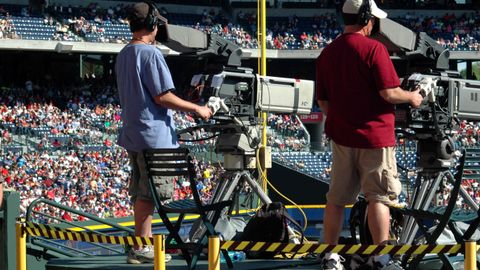
A camera cannot be placed wherever a director would like it, because it needs a platform, a cable route, a sightline and a position that does not obstruct spectators. Venues designed with coverage in mind build those platforms permanently into the structure, which is why the main camera position is always in the same place. Older venues require temporary rigging, which is expensive, slower and constrained by what the building will safely support.
This is why coverage from certain venues consistently offers angles that coverage from others does not, regardless of which broadcaster is present. The differences an audience notices between venues are usually differences in what the buildings allow rather than in production ambition.
Rehearsal, not improvisation
The crew arrives well before the audience and runs through the sequences that will be used, testing camera moves, replay routing and audio balance. Commentary positions are checked for sightlines and for the amount of crowd noise reaching the microphones, since both affect the audio balance. Graphics are loaded with everything the production expects to need, which is why a broadcast can display context instantly rather than assembling it live.
The rehearsal exists because there is no opportunity to fix anything once a live event starts, and every recoverable fault must be found beforehand. What looks effortless during a broadcast is the visible portion of a working day that began many hours earlier.
Why the world feed matters
A single production is usually designated the world feed, providing pictures and natural sound to every carrier that has bought coverage in any territory. Each carrier then adds its own commentary and presentation, which is why the pictures are identical across markets while everything else differs. The world feed is produced to a neutral brief, avoiding the partisan framing a domestic broadcaster might otherwise apply to one of the teams.
Carriers with larger budgets add their own cameras on top of the world feed, which is how one market gets angles that another does not. Understanding this division explains most of the differences an audience notices when comparing coverage of the same fixture from different countries.
- The compound is built and struck around every single fixture
- Power and connectivity are the limiting factors, not cameras
- Compound size directly limits how many angles are available
Also by Priya Patel
- Loyalty and membership schemes are queueing systems dressed as rewardsTicket Guides
- Watching an away match in a room full of the other side's supportersSports Bars & Pubs
- What a retractable roof does to a tennis day beyond keeping the rain offWimbledon
- What it takes to follow a team from the wrong side of the worldTop