Wimbledon
What a retractable roof does to a tennis day beyond keeping the rain off
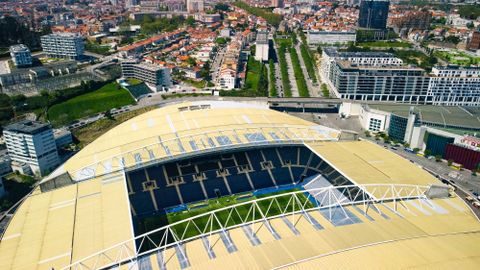
Closing a roof converts an outdoor match into an indoor one, and the change in light, air and sound alters the conditions of play and the experience of watching in ways that go far beyond continuity.
A roof is a climate system, not a lid
Covering a court traps air, and trapped air over a playing surface immediately begins to change in temperature and humidity because of the people and lighting inside. Venues therefore pair a roof with an air handling system whose job is to hold conditions steady rather than simply to keep spectators comfortable. Without that system the surface would sweat as warm humid air met a cooler court, producing exactly the slippery conditions the roof was closed to avoid.
The cycle of closing a roof and stabilising the air underneath takes time, which is why closure is a decision made in advance of the weather rather than in response to it. This is the part of a roof that spectators never see and that determines whether play can actually resume once the structure is shut.
Ball behaviour changes with the air
A ball travelling through denser, cooler air meets more resistance and behaves differently from the same ball travelling through the warm dry air of an open afternoon. Players consistently describe indoor conditions as slower and heavier, and they adjust their choices accordingly once a roof has been closed. The bounce off the surface also changes, because a court that has been under a closed roof holds a different amount of surface moisture than one under open sky.
On grass this matters more than on other surfaces, since a living playing surface responds to humidity in ways that a hard court does not. A match that begins outdoors and finishes under a roof is therefore played in two different sets of conditions, which is a genuine competitive variable.
Sound is the change spectators notice first
An open stadium loses most of its crowd noise upwards, which is why an outdoor arena can hold a large crowd and still feel relatively quiet. Closing the roof removes that escape route, and the same crowd making the same noise suddenly produces a much louder environment inside the bowl. Sound also begins to reflect off the underside of the structure, which lengthens the decay of every noise and makes applause run on rather than stopping cleanly.
Players notice this as a change in atmosphere, and spectators notice it as the match suddenly feeling more intense than it did minutes earlier. Venues manage the effect with absorptive treatment on the roof underside, which is why modern structures are lined rather than left as bare panels.
Artificial light replaces a moving sun
An outdoor court experiences shifting light through the day, with shadow creeping across the surface and one end frequently harder to play from than the other. Closing a roof and switching on the lighting removes that asymmetry entirely, giving both ends identical and unchanging conditions for the rest of the match. That is arguably fairer, but it also removes a feature of outdoor tennis that shaped tactics in the late afternoon for as long as the sport has been played.
Lighting for a covered court has to be even enough to avoid casting confusing shadows and bright enough for cameras without dazzling anyone looking upward. Meeting both requirements is why the lighting rigs in modern covered arenas are so much larger than the ones in older venues.
What a roof does to the schedule
The commercial reason for a roof is that it converts an uncertain session into a guaranteed one, which is what allows a tournament to promise evening play. That guarantee changes the whole shape of a tournament, since a covered court can absorb matches displaced from courts that have no protection. It also creates an imbalance within the same event, because players on covered courts complete their matches while others wait for weather that may not clear.
Tournaments manage this by concentrating the matches they most need to complete onto the protected courts, which is a scheduling advantage as much as a weather one. The roof therefore reshapes the competition itself rather than simply insuring it against rain.
- A closed roof changes ball behaviour by changing air and humidity
- Enclosure raises crowd noise sharply by removing the open sky
- Roofs guarantee a session, which changes how a tournament schedules
Also by Priya Patel
- Loyalty and membership schemes are queueing systems dressed as rewardsTicket Guides
- Watching an away match in a room full of the other side's supportersSports Bars & Pubs
- The outside broadcast compound is a small factory, and it explains a lot about coverageBroadcast Schedules
- What it takes to follow a team from the wrong side of the worldTop