Wimbledon
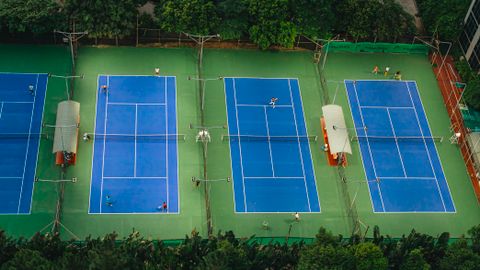
An outside court is a different thing to watch than a show court
The gap between a small court and a main arena is not just capacity; proximity, sound, sightline and crowd behaviour all change together, producing two experiences that happen to involve the same sport.
Proximity carries information
A spectator standing a few rows from a small court hears the ball leave the strings, which conveys pace and spin far more directly than watching the flight does. They also hear the players, whose breathing and footwork reveal how hard a rally is being worked in a way that no camera position can transmit. The angle from close to the surface makes it possible to see how low a ball stays and how much it deviates, details that flatten out from height and distance.
None of this is available in a large arena, where the compensation is a comprehensive view of the whole court and a clear read of positioning. The two vantage points answer different questions, which is why experienced spectators deliberately spend part of a day at each.
Crowd size changes crowd behaviour
A few hundred people around a court behave like a group who can all see each other, which restrains the more performative kinds of crowd behaviour. A large arena crowd is anonymous, and anonymity is what permits sustained chanting, coordinated noise and the occasional individual shouting into a silence. Reactions in a small crowd are also faster and more informed, since the people who sought out an obscure match tend to know why it is interesting.
That produces applause for things a large crowd would miss entirely, including good defensive work and points constructed rather than finished spectacularly. Players frequently describe outside courts as the more knowledgeable environment, even though the arena is the one that signals status.
Sightlines are set by geometry, not by ticket price
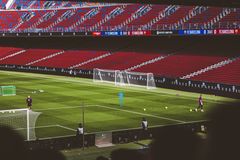
A small court has shallow raking, which means each row is barely higher than the one in front and any obstruction removes a large share of the view. A large arena is steeply raked precisely so that sightlines survive a full house, which is why a cheap seat high up often sees more than an expensive one at ground level. The trade is distance, since steep raking pushes the upper rows a long way from the surface and the players become small at exactly the point the view becomes complete.
Understanding this makes seat selection less about proximity and more about the angle at which the court presents itself from a given position. The best seats in most arenas are the ones high enough to see the whole court and low enough to still read what the players are doing.
Show courts are built for the cameras too
A main arena has to accommodate camera positions, lighting levels and the sightlines a broadcast requires, and those requirements are settled at design stage. That is why certain areas of a show court are kept clear, why the lighting is far more even than a small court needs, and why backdrops are plain. A plain, dark backdrop behind the baseline exists so that the ball is visible against it on camera, and it happens to help spectators as well.
Outside courts have none of this, so a spectator there is watching the sport in something much closer to its unmediated form. Neither is more authentic than the other, but they are shaped by different requirements and it shows in every detail of how they look.
Why the draw pushes everything towards the arena
The early rounds of a tournament distribute matches across every available court, which is the only period when outside courts hold significant tennis. As matches are completed the field contracts and the remaining fixtures migrate inward towards the courts with capacity and coverage. By the closing rounds the entire tournament is happening on one or two courts, and the outer courts are practice space and thoroughfare.
A spectator who prefers small courts is therefore choosing the beginning of a tournament rather than the end of it, which is the opposite of the usual preference. That inversion is one of the more useful things to know when deciding which day of a long tournament to attend.
- Proximity supplies information that distance removes
- Small crowds behave differently from large ones
- A show court is engineered for coverage as much as for spectators
Also by Michael Johnson
- Why a resale market forms the instant a ticket is worth more than its printed valueTicket Guides
- Why atmosphere is a structural property of a stand rather than a moodFan Zone
- Why some competitions protect a window in which no match may be shownBroadcast Schedules
- Why the way fans pay to watch keeps getting rebuilt every few yearsTop