Wimbledon
The queue as an entry system: how a physical line rations access to a tennis ground
A championship that admits people on the day is choosing to ration access by time and endurance rather than by price or by luck, and that choice shapes who ends up inside the grounds.
Rationing has to happen somehow
Any event where demand exceeds capacity has to choose a rationing mechanism, and the realistic options are price, chance, accumulated loyalty or time spent waiting. Price rations towards whoever can pay most, which concentrates the audience and removes the people for whom attendance is an occasional and effortful thing. Chance, in the form of a ballot, distributes more evenly but severs the connection between wanting to attend and actually attending, which some events consider a loss.
Time rationing admits whoever is willing to spend enough hours, which selects for commitment in a way that price and chance both fail to capture. A championship that keeps a physical queue has decided that this particular selection produces the crowd it wants inside the grounds.
What a physical line resists
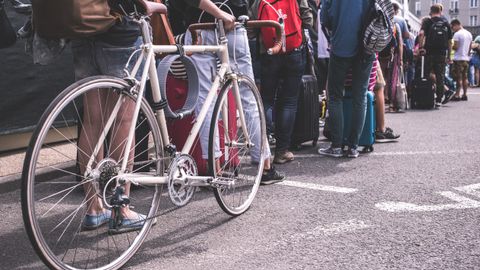
A queue made of people standing in a specific place is remarkably difficult to automate, because presence cannot be delegated to software the way a click can. That resistance is the point, since any online allocation system immediately attracts automated demand that outcompetes ordinary applicants by orders of magnitude. A physical line also constrains resale, because a place in it is only worth something to the person occupying it and cannot be transferred at scale.
The cost of this robustness is borne by the applicant, who has to be physically present for a long stretch rather than filling in a form. Events that have abandoned physical queueing usually rediscover the automation problem in a different form and have to build defences against it from scratch.
The queue develops its own conventions
A line that exists for many hours stops being a queue in the ordinary sense and becomes a temporary community with rules that participants enforce among themselves. Those conventions cover what counts as holding a place, how long someone may be absent, and what behaviour is acceptable from people who will be neighbours all night. Organisers formalise some of this and leave the rest to the participants, because a queue that polices itself needs far less staffing than one that does not.
Newcomers who treat the line as a mere inconvenience tend to breach conventions they did not know existed and are corrected quickly by people around them. Regulars, by contrast, often describe the queue as a genuine part of the event rather than as the price paid for attending it.
What the queue actually buys
Position in the line maps onto what is available at the far end, with the earliest arrivals reaching the choices that later arrivals will find gone. Beyond a certain position the entry available is general access to the grounds rather than a specific seat, which is a materially different day out. Because the mapping between position and outcome is roughly predictable, people self-select into arriving at the hour that matches what they actually want.
That self-selection is what keeps the system workable, since not everyone in the line is competing for the same thing. The precise arrangements, capacities and timings are set by the organiser for each edition and are the only authoritative version of how the system will run.
Why other events copy it badly
The visible part of a day queue is easy to imitate, and events regularly announce one as a gesture towards accessibility without building what sits underneath. What sits underneath is substantial: managed ground for people to occupy overnight, sanitation, stewarding, and a published method for counting positions. Without that infrastructure a queue becomes a crowd, and a crowd waiting for a limited number of entries in an unmanaged space is a safety problem rather than a system.
Events that get this right treat the queue as a venue in its own right, with its own plan, its own staff and its own capacity limits. Anything involving movement, capacity or overnight presence is governed by the venue operator and the local authority, whose instructions on the day take precedence over any general account.
- A queue rations by time spent rather than money paid
- Physical queues resist automation and resale in ways ballots do not
- The queue becomes a social space with its own conventions
Also by Tom Harrison
- Printed names and numbers fail in predictable ways, and the method explains whichMerchandise Reviews
- What separates a bar that shows sport from a bar built to watch sport inSports Bars & Pubs
- Why kick-off times move, and who is actually being served when they doBroadcast Schedules
- Why following one competition now means assembling coverage from several sourcesTop